In 2026, the K-Beauty market is driven by ingredient-first consumers. Shoppers check the INCI list before the brand name, and ingredient-analysis content routinely garners millions of views on social media. The ingredients you choose can make or break your product.
Niacinamide product sales surged 340% year-over-year. The global peptide cosmetics market surpassed USD 3.6 billion in 2026. These numbers prove that correctly reading ingredient trends dramatically increases your chances of creating a hit product. In this guide, we break down the top 10 skincare ingredients of 2026 with market data, raw material costs, and formulation strategies — essential reading for any brand sourcing ingredients from Korea.
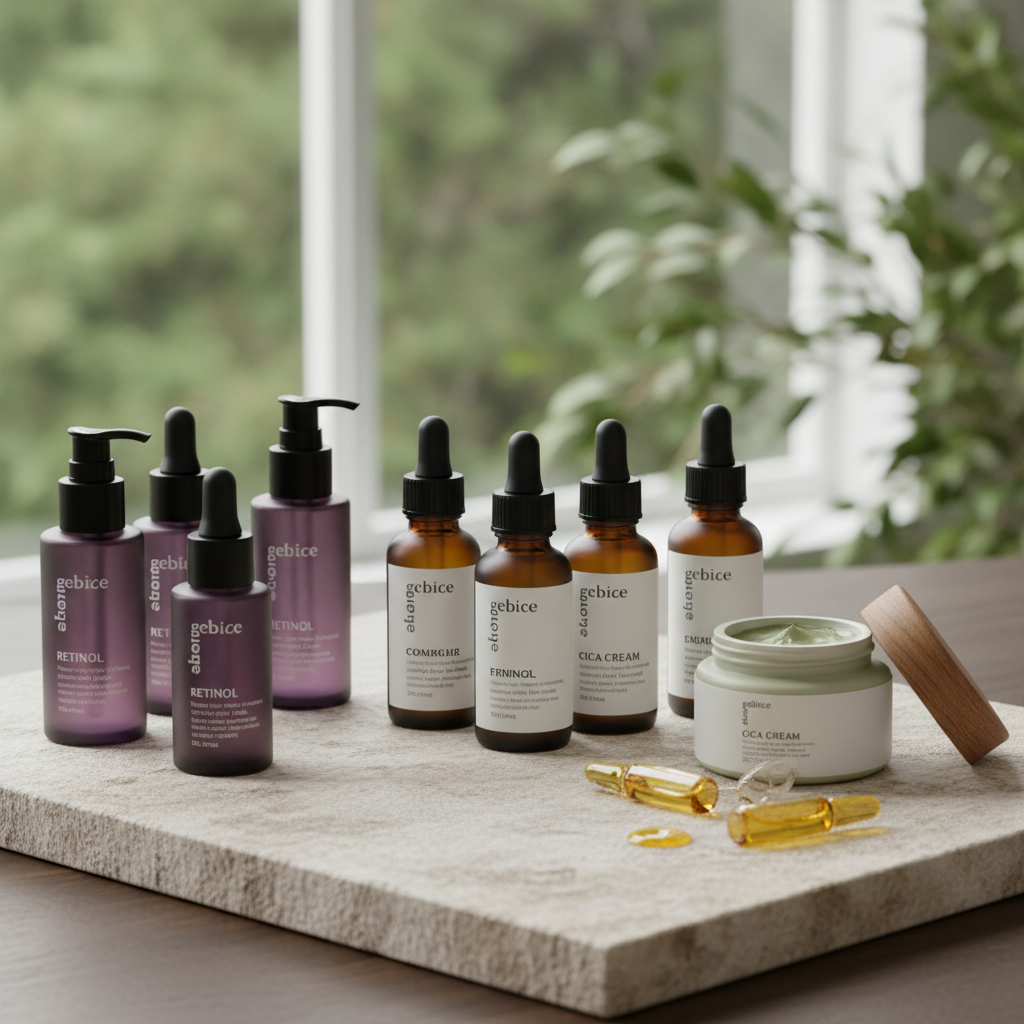
1. Peptides — The Undisputed Leader in Anti-Aging
The global peptide cosmetics market has surpassed USD 3.6 billion in 2026, growing at a CAGR of 9.4%. With clinically proven benefits in collagen synthesis, wrinkle reduction, and skin elasticity, peptides have become the core ingredient in premium anti-aging lines worldwide.
- Key peptides: Acetyl Hexapeptide-8 (Argireline), Copper Peptide (GHK-Cu), Palmitoyl Tripeptide-1
- Market size: Approx. USD 3.6 billion globally (2026)
- Core benefits: Wrinkle reduction, collagen synthesis, skin firming
- Ideal formats: Serums, ampoules, eye creams, moisturizers
2. Retinol — The Gold-Standard Anti-Aging Ingredient Evolves
Retinol (Vitamin A) remains one of the few ingredients with FDA-recognized wrinkle-reduction efficacy. In 2026, encapsulated retinol and slow-release retinol formulations that minimize irritation are dominating the market, pushing the global retinol cosmetics market to approximately USD 2.3 billion.
- Market size: Approx. USD 2.3 billion globally (CAGR 7.8%)
- Core benefits: Cell turnover acceleration, wrinkle reduction, hyperpigmentation correction
- Key trends: Encapsulated retinol, microbiome-friendly retinol formulas
3. Niacinamide — The Multi-Tasker with Explosive Growth
Niacinamide (Vitamin B3) is the ingredient showing the most explosive growth in 2026. Delivering brightening, pore-minimizing, barrier-strengthening, and oil-balancing benefits with minimal irritation, it has earned the title of the ultimate "do-it-all" active suitable for all skin types.
Notably, niacinamide product sales grew 340% year-over-year, and the global niacinamide cosmetics market has reached approximately USD 2.0 billion. K-Beauty brands are racing to launch high-concentration 10% niacinamide products.
4. Centella Asiatica (Cica) — K-Beauty's Signature Ingredient
Cica is derived from Centella Asiatica and has become the defining soothing and repair ingredient of K-Beauty. The global Cica cosmetics market stands at approximately USD 1.4 billion, with particularly strong demand in Asian and European markets.
- Market size: Approx. USD 1.4 billion globally (CAGR 8.2%)
- Core benefits: Skin soothing, wound recovery, barrier reinforcement
- Active compounds: Madecassoside, Asiaticoside, Asiatic Acid
5. Vitamin C — The Brightening Benchmark
Vitamin C (Ascorbic Acid) remains a perennial favorite for its powerful antioxidant and brightening effects. In 2026, stabilized Vitamin C derivatives (Ethyl Ascorbyl Ether, Ascorbyl Glucoside) are the mainstream choice, with the market reaching approximately USD 1.8 billion.
6. Hyaluronic Acid — The Hydration King Enters the Multi-Weight Era
Hyaluronic acid can hold up to 1,000 times its weight in water, making it the gold standard of hydration. In 2026, multi-weight HA formulas — layering low, medium, and high molecular weight hyaluronic acid — are the dominant trend. The global HA cosmetics market has reached approximately USD 3.0 billion.
7. Madecassoside — High-Purity Cica Takes Center Stage
High-purity madecassoside — isolated from Centella Asiatica extract — is emerging as a distinct ingredient category. Delivering stronger soothing and repair effects than standard Cica products, it has become the core ingredient for sensitive-skin lines. The high-purity madecassoside raw material market grew 220% year-over-year.
8. Bakuchiol — The Rise of Plant-Based Retinol
Bakuchiol is extracted from the seeds of Psoralea corylifolia (Babchi) and delivers retinol-like anti-aging benefits without irritation, making it safe for sensitive skin and pregnancy. The global bakuchiol cosmetics market is valued at approximately USD 610 million, growing at a CAGR of 12.3% — the fastest growth rate of any ingredient on this list.
- Clinical evidence: 12-week study showed 0.5% bakuchiol matched 0.5% retinol in wrinkle reduction (British Journal of Dermatology)
- Target audience: Sensitive skin, pregnancy-safe, vegan consumers
- Key trend: Core anti-aging active in clean beauty and vegan beauty lines
9. Probiotics — The Heart of Microbiome Skincare
Probiotic skincare that rebalances the skin's microbiome (microbial ecosystem) has emerged as a major trend in 2026. Lactobacillus ferment filtrate, Bifida extract, and similar ingredients deliver barrier-strengthening, soothing, and anti-inflammatory benefits. The global probiotic cosmetics market has reached approximately USD 1.1 billion (CAGR 10.1%).
10. Glutathione — From Ingestible Supplements to Topical Skincare
Glutathione — a potent antioxidant and brightening agent — has expanded beyond ingestible supplements into topical skincare. Liposomal encapsulation technology has dramatically improved skin absorption rates, driving 180% year-over-year growth in the glutathione cosmetics segment. In Korea and Japan, glutathione ampoules and tone-up creams have become a fast-growing product category.
Ingredient Cost, Trend Index & Hero Products Compared
The table below compares each ingredient's raw material cost (per kg), trend index (based on search volume and sales data), and representative hero products as of 2026. Use this data to evaluate cost-versus-impact when planning your next product.
| Ingredient | Raw Cost (per kg) | Trend Index | Market Size | Hero Products |
|---|---|---|---|---|
| Peptides | USD 580–2,170 | ★★★★★ | USD 3.6B | Estee Lauder ANR, Innisfree Retinol Cica Ampoule |
| Retinol | USD 360–1,090 | ★★★★★ | USD 2.3B | La Roche-Posay Retinol B3, Bioderma Pigmentbio |
| Niacinamide | USD 36–110 | ★★★★★ | USD 2.0B | The Ordinary Niacinamide 10%, Torriden DIVE-IN Serum |
| Centella Asiatica (Cica) | USD 72–290 | ★★★★☆ | USD 1.4B | Dr.Jart+ Cicapair, La Roche-Posay Cicaplast |
| Vitamin C | USD 22–220 | ★★★★☆ | USD 1.8B | Klairs Freshly Juiced, Obagi Pro-C Serum |
| Hyaluronic Acid | USD 110–580 | ★★★★☆ | USD 3.0B | Torriden DIVE-IN Serum, Heparin HA Ampoule |
| Madecassoside | USD 220–870 | ★★★★☆ | USD 580M | Skin1004 Madagascar Ampoule, IOPE Derma Repair Cica Cream |
| Bakuchiol | USD 430–1,450 | ★★★★★ | USD 610M | Ole Henriksen Goodnight Glow, Herbivore Bakuchiol Serum |
| Probiotics | USD 145–720 | ★★★★☆ | USD 1.1B | Lancome Genifique, Aestura Atobarrier 365 Cream |
| Glutathione | USD 290–1,300 | ★★★★☆ | USD 470M | Bio Heal BOH Probioderm Glutathione Ampoule, Cell Fusion C Glutathione Cream |
The most cost-efficient ingredients are niacinamide (USD 36–110/kg) and Vitamin C (USD 22–220/kg). Peptides and bakuchiol command higher raw material costs but enable premium product positioning with higher margins.
2026 Ingredient Trend Keywords
- Multi-functional actives: Consumers favor ingredients like niacinamide that deliver brightening + hydration + barrier support in one
- Minimal irritation: Encapsulated retinol, bakuchiol — technologies that maintain efficacy while reducing sensitivity
- Microbiome skincare: Rapid growth of probiotic-based products that restore the skin's microbial ecosystem
- High-purity & high-concentration: Consumers prioritize concentration and purity over ingredient count (e.g., 10% niacinamide, 20% Vitamin C)
- Clean & vegan transition: Accelerating shift from animal-derived to plant-based and fermentation-derived alternatives
Ingredient Selection Strategy for Brand Owners
Knowing the trending ingredients is one thing — turning them into successful products is another. Here is a strategic framework for brands sourcing from Korean manufacturers.
- Reverse-engineer your target audience: Early 20s → Niacinamide + Vitamin C | 30s–40s → Peptides + Retinol | Sensitive skin → Cica + Bakuchiol
- Differentiation points: Go beyond listing ingredients — differentiate through patented delivery systems (liposomal, encapsulated) or high concentrations
- Price positioning: Niacinamide and Vitamin C for value lines; peptides and bakuchiol for premium lines
- Verify OEM capabilities: Choose a Korean manufacturer with proven experience stabilizing your target ingredient in the desired format
Frequently Asked Questions (FAQ)
Q. What are the most in-demand skincare ingredients in 2026?
By global market size: peptides (USD 3.6B), hyaluronic acid (USD 3.0B), and retinol (USD 2.3B). By growth rate: bakuchiol (CAGR 12.3%), probiotics (CAGR 10.1%), and peptides (CAGR 9.4%) are growing the fastest.
Q. Why is niacinamide so popular?
Niacinamide delivers brightening, pore-minimizing, barrier-strengthening, and oil-balancing benefits while being one of the most affordable raw materials (USD 36–110/kg). Its 340% YoY sales growth speaks for itself — it's the ultimate performance-per-dollar ingredient.
Q. Can bakuchiol replace retinol?
Clinical research shows that 0.5% bakuchiol produced wrinkle-reduction results comparable to 0.5% retinol over 12 weeks. It's gentler on sensitive skin, but complementary use alongside retinol is generally recommended rather than full replacement.
Q. How can small brands incorporate trending ingredients?
Partner with a Korean OEM/ODM manufacturer. HWAJAE provides end-to-end support — from ingredient trend analysis and formulation design to manufacturer matching. Production starts from 1,000 units, and you can check estimated costs using the free quote calculator.
Build Your Product with Trending Ingredients
Use the HWAJAE quote calculator to check estimated costs by ingredient in 30 seconds. Partnered with 30+ GMP-certified Korean manufacturers.
Free Quote Calculator